
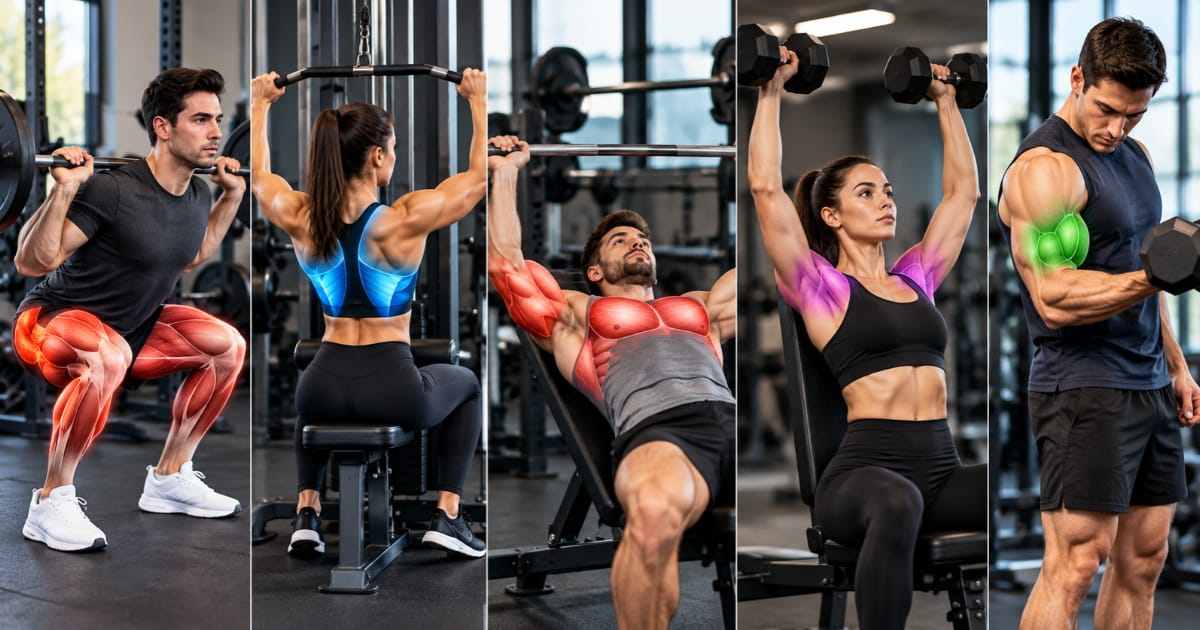
Training the right muscle groups together can help you get more out of your workouts. Exercises like lateral raises and side lateral raises target the shoulder muscles and can be part of an effective training routine. How you group your workouts may also affect your overall health, including blood glucose and lipid levels. This guide covers the best muscle group combinations to improve your workouts, support your well-being, and make the most of your training time.
What are the different muscle groups?
The major muscle groups can be categorized into three primary types: skeletal, smooth, and cardiac.
- Cardiac Muscle: Unique to the heart, this muscle operates involuntarily and is characterized by its striated appearance. It is vital for pumping blood throughout the body, maintaining circulation and oxygen supply.
- Smooth Muscle: Found in the walls of hollow organs such as the intestines, blood vessels, and bladder, smooth muscle also functions involuntarily. Its slow, rhythmic contractions assist in processes like digestion and blood flow regulation.
- Skeletal Muscle: These muscles are attached to bones and are responsible for voluntary movements. They come in various types, including slow-twitch (for endurance) and fast-twitch (for explosive actions), allowing for a diverse range of physical activities.
Knowing the body’s major muscle groups is essential for developing effective training programs. When discussing muscle groups, we typically emphasize skeletal muscles, which can be categorized as follows:
- Chest (Pectorals)
- Back (Lats and Traps)
- Shoulders (Deltoids)
- Arms (Biceps and Triceps)
- Core (Abdominals and Obliques)
- Legs (Quadriceps, Hamstrings, Calves)
- Glutes (Gluteus Maximus and Medius)
Training these groups effectively can enhance functional strength and improve overall physique. For example, incorporating compound movements like squats and deadlifts not only engages legs and glutes but also recruits your core and back, making workouts more efficient.
Compound vs. Isolation Exercises
Compound movements, such as squats, deadlifts, and bench presses, work multiple muscle groups and joints at the same time. They help build overall strength, improve coordination, and make workouts more efficient. For example, squats target the quadriceps, hamstrings, glutes, and core, while bench presses work the chest, shoulders, and triceps.
Isolation exercises focus on one main muscle group and usually involve movement at a single joint. Examples include bicep curls for the biceps and tricep extensions for the triceps. These exercises help target specific muscles, address muscle imbalances, and support bodybuilding goals.
Both compound movements and isolation exercises can be useful in a fitness routine. Compound movements help build overall strength, while isolation exercises allow you to focus on specific muscles. Including both can help you create a balanced workout based on your fitness goals.
Which Muscle Groups to Pair Together: Beginners vs. Advanced
Knowing which muscle groups to train together makes planning easier. For beginners training two to three days a week, pairing complementary muscles is a simple way to build a solid foundation. Chest and triceps or back and biceps work well together and make workouts more efficient.
- Chest and Triceps: When you push heavy on chest exercises, your triceps are already engaged, making for an efficient workout.
- Back and Biceps: Pulling movements for the back naturally work the biceps, allowing for a comprehensive upper-body session.
A simple 3-day workout schedule could look like this:
- Day 1: Chest and Triceps
- Day 2: Back and Biceps
- Day 3: Legs and Core
Advanced Lifters: Targeted Splits for Growth
Experienced lifters can benefit from more nuanced training through push-pull and upper-lower splits. A practical 4-day schedule could be:
- Day 1: Push (Chest, Shoulders, Triceps)
- Day 2: Pull (Back, Biceps)
- Day 3: Legs (Quads, Hamstrings, Glutes)
- Day 4: Upper Body (Chest, Back, Shoulders)
This approach helps organize workouts by muscle group, but proper recovery depends on exercise intensity, training volume, and how often each muscle is trained.
Recovery and Its Importance
Recovery is vital, regardless of your fitness level. Muscles need time to repair and grow stronger, and this need varies based on workout intensity and individual capacity. Beginners may find two days of rest sufficient, while advanced lifters might require up to three days between similar muscle group workouts to achieve optimal results. Balancing workout intensity with proper recovery allows for sustainable strength gains and overall well-being.
Example of a Weekly Workout Schedule Organized by Muscle Groups
Creating a weekly workout schedule organized by muscle groups not only streamlines your training but also ensures a balanced approach between exercise and recovery. Pairing muscle groups on the same day lets you focus on specific areas while the others rest, which is crucial for growth and strength. Here is a simple plan showing which muscle groups to workout on each day.
Monday: Chest and Triceps
- Bench Press: 3 sets of 8-10 reps
- Push-Ups: 3 sets of 10-15 reps
- Bench Dips: 3 sets of 8-12 reps
Wednesday: Back and Biceps
- Bent-Over Rows: 3 sets of 8-10 reps
- Pull-Ups (or Assisted Pull-Ups): 3 sets of 5-8 reps
- Biceps Curls: 3 sets of 10-12 reps
Friday: Legs and Core
- Squats: 3 sets of 8-10 reps
- Lunges: 3 sets of 10 reps per leg
- Plank: 3 sets of 20-30 seconds
Rest days between strength training sessions are important to allow your muscles to recover and grow. Depending on the intensity and individual recovery needs, you may benefit from one or two active rest days, which could include light cardio or stretching. Feel free to adjust this schedule to match your goals and experience level.
What are the different forms of resistance training?
Resistance training encompasses a variety of methods, each offering unique benefits tailored to different fitness goals. One prominent form is free weights, which includes dumbbells and barbells. This approach not only strengthens target muscles but also engages stabilizing muscles, improving overall balance and coordination.
For those seeking a structured routine, machine-based resistance provides guided movements that can help users maintain proper form, making it ideal for beginners and rehabilitation settings.
Bodyweight exercises, such as push-ups and squats, use your own body weight to build strength and improve flexibility. They can be done almost anywhere, making them a practical option for people who do not have gym equipment or have limited time.
Resistance bands have gained popularity for their versatility and portability, offering adjustable tension to challenge muscles in various planes of movement. Each method can be combined in creative ways to keep workouts stimulating and effective, catering to a diverse range of fitness enthusiasts.
Types of Muscle Contractions and Training Methods
- Isometric exercises, where the muscle length remains unchanged during contraction, are excellent for building strength at specific joint angles. This can be particularly useful for athletes looking to enhance stability in particular movements.
- Isotonic exercises, characterized by muscle length changes, can be further divided into concentric (muscle shortening) and eccentric (muscle lengthening) contractions, each offering unique benefits for overall muscle development.
- Isokinetic training, for instance, utilizes specialized equipment to ensure constant speed throughout the range of motion, which not only builds strength but also targets specific muscle groups more effectively.
- Eccentric training emphasizes the lowering phase of movement. This type of contraction has been shown to produce greater muscle hypertrophy and strength gains compared to concentric movements alone. By focusing on the controlled lengthening of muscles, athletes can enhance their performance in sports that require quick changes in direction or explosive movements.
- Adding plyometric training to a workout routine introduces explosive movements that develop power, coordination, and agility.
Is yoga resistance training
Yoga can function as a form of resistance training because it requires the body to work against its own weight and gravity. Poses like Warrior II and Plank engage multiple muscle groups, helping improve muscle strength, endurance, and stability.
Many yoga postures involve isometric holds, which require muscles to remain engaged without external weights. These poses also improve body control and muscle awareness. In addition, yoga emphasizes proper alignment and breath control, which can support muscular endurance. Consistent yoga practice can complement traditional resistance training by combining strength-building with flexibility and balance.
Best Exercises for Each Muscle Group
Chest
- Bench Press: A classic for building overall strength and mass.
- Push-Ups: Variations like incline and decline push-ups maximize muscle activation.
- Chest Flys: Use dumbbells or cables to isolate pectoral muscles effectively.
Back
- Deadlifts: Essential for overall back development, targeting both the lower and upper regions.
- Pull-Ups: Excellent for enhancing upper back strength and improving grip.
- Bent-Over Rows: Focus on form to fully engage your lats and rhomboids.
Arms
- Biceps Curls: Incorporate variations like hammer curls for a broader biceps focus.
- Triceps Dips: Utilize body weight or add resistance for greater intensity.
- Skull Crushers: A great isolation exercise for maximizing triceps gains.
Shoulders
- Overhead Press: Builds shoulder size and stability, crucial for functional strength.
- Lateral Raises: Target the lateral deltoids to enhance width.
- Front Raises: Focuses on the anterior deltoids for balanced shoulder definition.
Legs
- Squats: Engage your quadriceps, hamstrings, and glutes while improving core stability.
- Lunges: Target the entire lower body, enhancing balance and flexibility.
- Leg Press: Focuses on thigh and glute strength, allowing for heavier loads without strain on the back.
Core
- Planks: Activate abdominal muscles and lower back, promoting endurance and stability.
- Russian Twists: Strengthen obliques and improve rotational strength, essential for functional movements.
- Bicycle Crunches: Engage multiple core muscles, providing a dynamic workout that enhances coordination.
Final Thoughts
Effectively pairing muscle groups during workouts can significantly enhance your training regimen and lead to better results. By understanding which muscle groups to workout together, you can maximize your strength gains and promote muscle growth.
Consider popular combinations, such as pairing chest with triceps, back with biceps, or legs with core, to create efficient workout sessions. It’s also important to incorporate rest days to allow for recovery. With this knowledge, take the time to design a balanced workout schedule that suits your fitness goals and adjust it as you progress.