
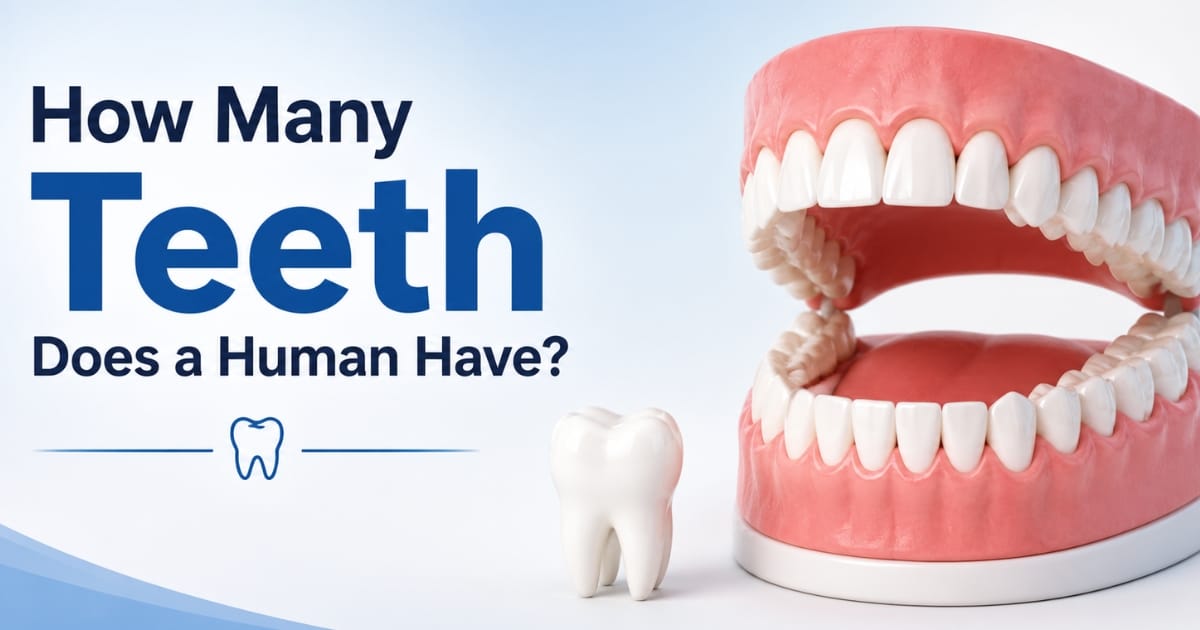
Knowing the facts about human dentition is essential for making informed choices regarding oral hygiene and dental care. Each tooth has an important role in biting, chewing, and breaking down food. If you have ever wondered how many teeth does a human have, the short answer is 20 baby teeth and 32 permanent teeth over a lifetime.
Quick Checklist Before You Count Your Teeth
- Know that baby teeth and adult teeth are two completely different sets, not the same teeth growing back
- Check if your wisdom teeth have already come in, are still under the gum, or were removed
- Count each arch separately, since the top and bottom often develop on slightly different timelines
- Remember that a missing or extracted tooth will lower your personal count below the standard number
- Ask your dentist for a panoramic X ray if you are unsure how many teeth are still under your gums
- Keep in mind that dental implants or bridges replace the function of a tooth but are not natural teeth
- Track your child’s tooth loss on a simple chart so you know what to expect at each age
Humans grow two full sets of teeth over a lifetime. The first set, known as baby teeth, totals 20. The second set, known as permanent teeth, totals 32, including the four wisdom teeth that arrive last.
Baby Teeth Numbers

Babies are not born with visible teeth, but the groundwork is already there under the gums. The first primary tooth usually appears around 6 months of age, and by age 3, all 20 baby teeth have typically come in, split evenly with 10 on top and 10 on bottom. They are smaller and whiter than adult teeth and hold space in the jaw for the permanent teeth that will eventually replace them.
Adult Teeth Numbers
Once every baby tooth has been replaced and the wisdom teeth have erupted, an adult mouth holds 32 permanent teeth, evenly split with 16 on the top arch and 16 on the bottom. This full count is considered complete around the late teens to mid twenties, since wisdom teeth are usually the last to arrive and sometimes never fully appear at all.
A young jaw is smaller, so it can only fit 20 primary teeth comfortably. As the jaw grows through childhood and the teenage years, there is finally enough room for the larger set of 32.
Breaking Down the Types
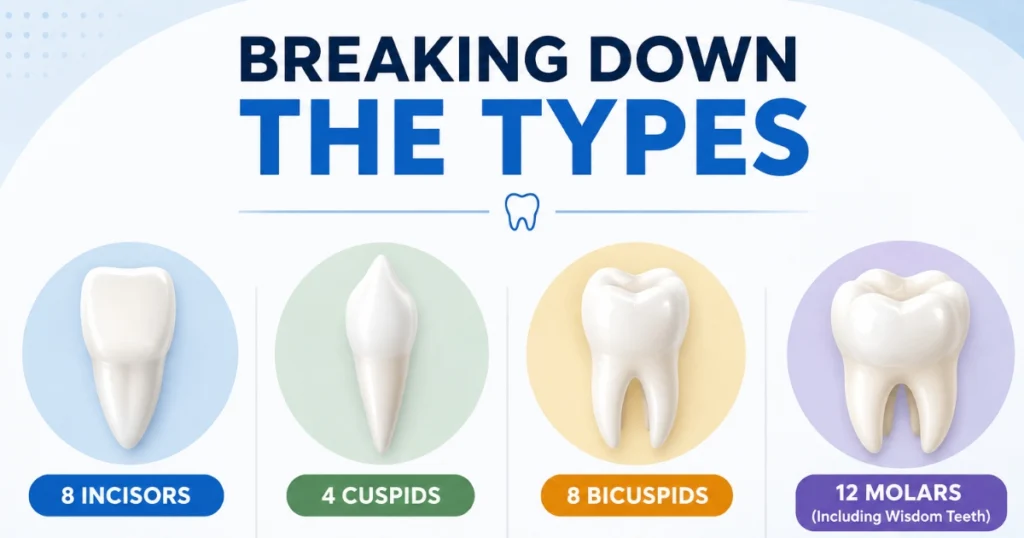
The 32 permanent teeth fall into four categories, and each one is built for a specific job.
Incisors (8 total) sit at the center of your smile, four on top and four on bottom. They are the first baby teeth to erupt and the first permanent teeth to replace them, usually starting around age 6. Their flat, thin edges work like a small chisel, perfect for that first bite of food.
Cuspids or canines (4 total) sit two on top and two on bottom. Primary cuspids usually come in between 16 and 20 months, while the permanent versions arrive around age 9. Their sharp point is designed for tearing tougher foods.
Bicuspids or premolars (8 total) are split evenly between the top and bottom arches, larger than incisors and cuspids but smaller than molars. They do not appear until around age 10, and there is only ever one set since they have no baby tooth predecessor. Their flatter, ridged surface helps grind food before it reaches the back teeth.
Molars (12 total, including wisdom teeth) are the largest and strongest teeth, with 6 on top and 6 on bottom. The first molars usually erupt around age 6, the second set around age 12, and the third set, better known as wisdom teeth, often arrives between ages 17 and 25.
Wisdom Teeth
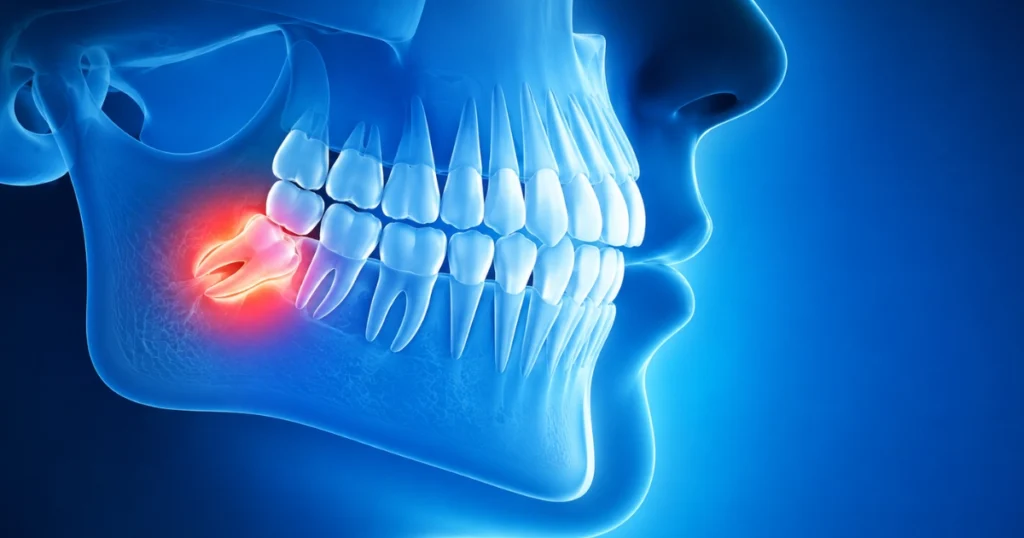
Wisdom teeth are the third and final set of molars, and there are normally 4 of them. Many people end up having them removed because modern jaws are often too small to fit them properly. Scientists believe wisdom teeth are left over from earlier human ancestors, who had larger jaws and needed extra chewing power for a tougher diet. Today they are more likely to cause crowding, pain, or infection than to actually help with chewing.
Without Wisdom Teeth
Since a large number of adults have their wisdom teeth removed, it is common to have 28 teeth instead of the full 32. This is considered a normal, healthy number. In fact, many dentists consider 28 teeth to be the practical adult number, since wisdom teeth often cause more problems than benefits once modern jaw size is factored in.
When Baby Teeth Start Falling Out
Baby teeth usually begin to loosen and fall out around age 6, starting with the lower incisors. This process continues gradually until around age 12 or 13, when the last baby molars are typically replaced.
Age Chart
| Age | Milestone |
|---|---|
| 6 months to 3 years | 20 primary teeth fully in place |
| Age 6 | First permanent molars and incisors begin erupting |
| Age 9 to 12 | Cuspids and bicuspids replace their baby tooth counterparts |
| Age 12 | Second set of permanent molars typically erupts |
| Age 17 to 25 | Wisdom teeth may erupt, completing the full 32 |
Missing or Extracted Teeth
Teeth can be lost to decay, injury, gum disease, or necessary extraction, and each of these lowers your personal total below the standard 32. A missing tooth does not just affect appearance. It can shift nearby teeth over time, change your bite, and make chewing less efficient on that side of the mouth.
Dental Implants or Bridges
When a tooth is lost, many people choose to replace it with an implant or a bridge. These restore the function and look of a natural tooth, though they are not counted as biological teeth. An implant is anchored directly into the jawbone, while a bridge relies on the neighboring teeth for support.
Why It Matters for Oral Health
Knowing your tooth count is not just trivia. It helps you notice when something is off, like a tooth that never erupted or one that was lost without you realizing the long term impact. Understanding the roles of incisors, cuspids, bicuspids, and molars also makes it easier to understand why dentists recommend certain habits, from flossing between tight back teeth to protecting front teeth during sports.
Fun Facts Worth Knowing
- Humans are considered diphyodont, meaning we only grow two sets of teeth in a lifetime, unlike some animals that regrow teeth continuously
- Tooth enamel is the hardest substance in the human body, even harder than bone
- No two people have identical tooth patterns, similar to how fingerprints are unique
- Wisdom teeth got their name because they tend to arrive in early adulthood, a time historically associated with gaining wisdom
- The first tooth to erupt in most babies is a lower central incisor
Frequently Asked Questions
1. How many teeth does a human have in total?
Adults typically have 32 permanent teeth once everything has erupted, including 8 incisors, 4 cuspids, 8 bicuspids, and 12 molars.
2. How many teeth does a human have as a child before adult teeth come in?
Children have 20 primary teeth, known as baby teeth, before permanent teeth begin replacing them around age 6.
3. How many teeth does a human have without wisdom teeth?
Most adults who have had their wisdom teeth removed end up with 28 teeth, which is considered a completely normal and functional number.
4. How many teeth does a human have on each arch?
A full adult mouth splits evenly, with 16 teeth on the top arch and 16 teeth on the bottom arch.
Final Thoughts
The number of teeth in your mouth tells a small story about your own growth, from that very first baby tooth to the last wisdom tooth that may or may not have room to grow in. Knowing the difference between primary and permanent teeth, and understanding what each type is built to do, makes it a lot easier to appreciate why dental care matters so much.